
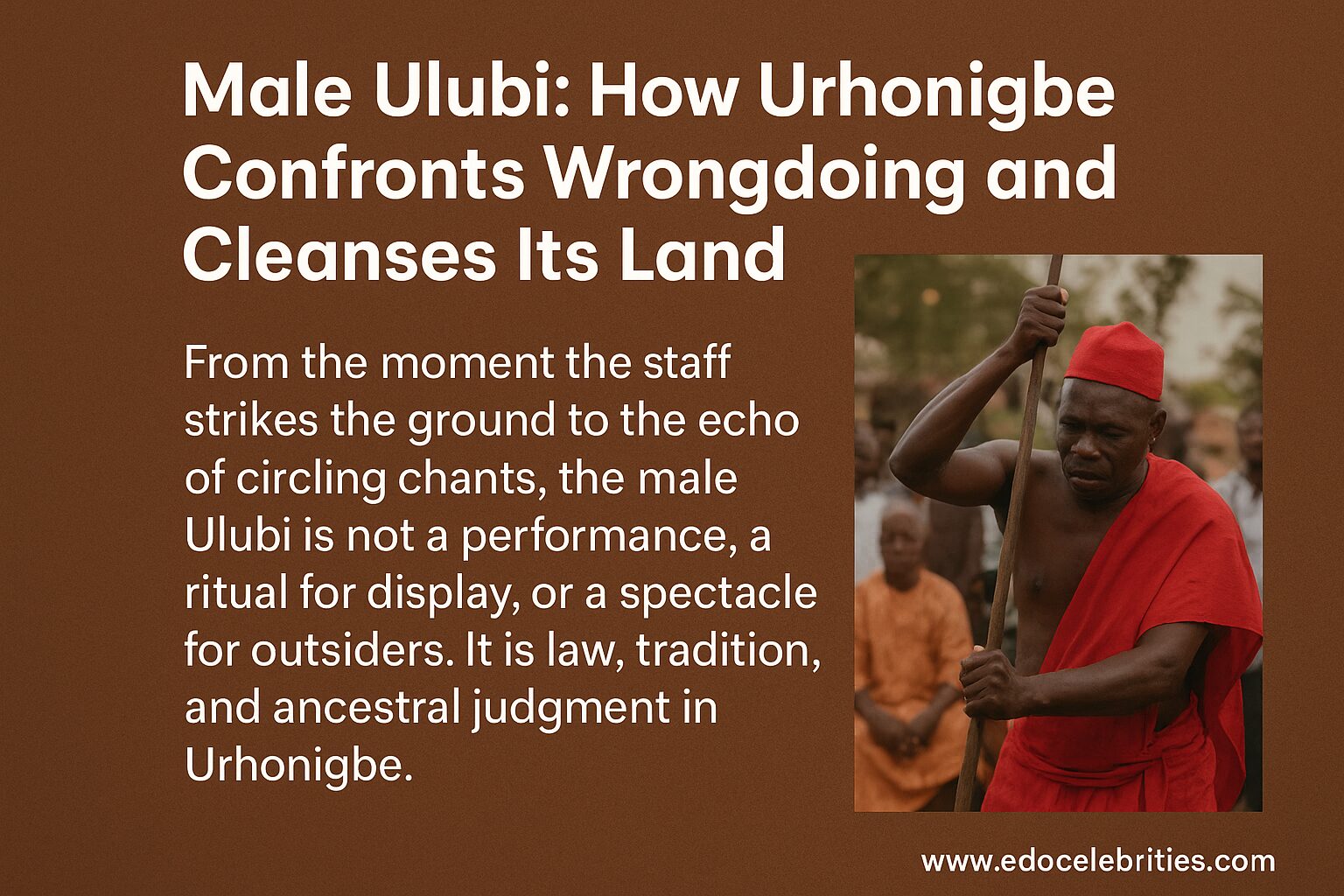
From the moment the staff strikes the ground to the echo of circling chants, the male Ulubi is not a performance, a ritual for display, or a spectacle for outsiders. It is law, tradition, and ancestral judgment in Urhonigbe.
In this ancient Edo community, wrongdoing is not ignored, delayed, or outsourced. When moral order is broken, the land itself must be addressed — and the Ulubi is how that reckoning begins.
The male Ulubi represents communal authority backed by ancestral mandate. Every movement, chant, and procession carries meaning. The striking of the ground is a summons — not just to the living, but to the ancestors believed to oversee justice, truth, and balance within the land. The circling chants are declarations: accusations are acknowledged, wrongdoing is named, and the community is placed under spiritual witness.
Unlike modern systems that rely solely on paperwork and distant courts, the Ulubi confronts wrongdoing openly. It serves as both warning and cleansing. Those found guilty are believed to face consequences not just socially, but spiritually — consequences that cannot be escaped by denial or influence.
This process reinforces accountability. It reminds every member of the community that actions affect the collective, and that no one stands above ancestral law. The land must be cleansed so peace can return. Silence is not neutrality; justice must be spoken aloud.
In Urhonigbe, the Ulubi is how balance is restored. It is how truth is enforced. It is how the land remembers itself.
This is not folklore.
This is tradition.
This is law.
This is ancestral accountability.

Leave a Reply