
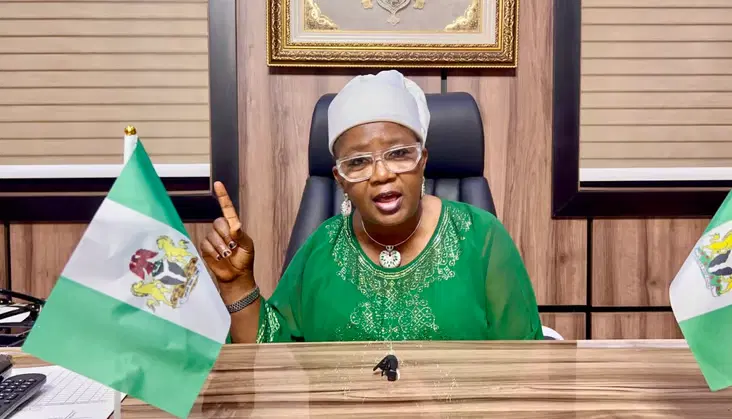
BENIN CITY – The Benin Traditional Institution has once again demonstrated its authority in preserving cultural heritage, as the Palace of His Royal Majesty, Omo N’Oba N’Edo Uku Akpolokpolo, Oba Ewuare II, firmly shut down attempts to introduce the controversial ‘Iyaloja’ title into Edo’s market system.
For weeks, media spaces buzzed with reports of the inauguration of an “Iyaloja of Edo Market”, allegedly supported by the Iyaloja-General of Nigeria, Mrs. Folashade Tinubu-Ojo, daughter of President Bola Tinubu. However, what appeared to be a ceremonial appointment soon turned into a cultural and political confrontation after the Oba of Benin declared that the Iyaloja concept is alien to Benin customs and traditions.
Palace Rejects Political Infiltration
According to palace sources and documents sighted by Vanguard, the group behind the move — operating under the name National Market Council of Nigeria (NAMCOM) — had written to both the Edo State Government and the Benin Palace as far back as 2024, seeking approval for the introduction of the Iyaloja structure in the state.
However, without any official consent, the purported inauguration was reportedly held before the delegation’s courtesy visit to the palace — a move that the Oba of Benin strongly disapproved.
During their visit, Oba Ewuare II reminded Mrs. Tinubu-Ojo and her entourage that Benin markets operate under the traditional “Iyeki” system, where each market has its own female leader, chosen by market women and later confirmed by the palace — not politically appointed.
“In Benin Kingdom, there is no single woman who controls all the markets. Every market has its own Iyeki, chosen by the traders and blessed by the palace. The concept of Iyaloja is alien to our culture,” the Oba said firmly.
A Cultural Stand Against Political Manipulation
Behind the façade of market leadership, palace insiders believe the motive for introducing the Iyaloja structure in Edo had strong political undertones, allegedly aimed at mobilising market women’s support ahead of the 2027 general elections.
But that strategy failed to gain traction in Benin, largely due to the palace’s swift and decisive rejection. Oba Ewuare II convened a meeting of all market leaders (Iyekis) in Benin City and directed that where disputes existed between factions loyal to the new Iyaloja appointees and others, fresh leadership should be democratically selected by the market women and confirmed by the palace.
The Oba also warned against using traditional titles or markets for partisan politics, emphasizing that Benin culture does not recognize honorary or politically motivated market titles.
The Benin Traditional Council’s Position
In a widely circulated statement signed by five senior palace chiefs and Frank Irabor, Secretary of the Benin Traditional Council (BTC), the palace clarified its long-standing position:
“For the avoidance of doubt, there is nothing like ‘Iyeki General’ or ‘Iyaloja’ in Benin culture. Each Iyeki is chosen by the market women and confirmed by the Palace. Every Iyeki is spiritually and culturally tied to the Oba. Any attempt to politicize this tradition is a violation of our customs.”
The Council also expressed concern over the increasing trend of politicians exploiting markets as platforms for influence, describing it as “a dangerous erosion of cultural order.”
BTC warned that if the Iyaloja model were to be accepted in Edo, it could trigger unrest and distort a system that has functioned harmoniously for centuries.
The Cultural Roots of ‘Iyaloja’
The Iyaloja institution, though highly respected in Yoruba culture, has no historical roots in Benin Kingdom. Originating among the Yoruba people of southwestern Nigeria, “Iyaloja” literally means “Mother of the Market” — a position of authority and influence among market traders.
In Lagos and other Yoruba-speaking regions, the Iyaloja General serves as the umbrella leader for market associations, a role historically held by figures like Madam Abibatu Mogaji and now Mrs. Folashade Tinubu-Ojo.
But as the Benin Traditional Council pointed out, every cultural system is distinct. In Benin, market leadership is decentralized, spiritual, and linked directly to the palace through rituals and traditional responsibilities.
Tradition Above Politics
The Benin Palace’s decision has been widely praised by cultural enthusiasts and traditional institutions across Edo State as a bold defense of indigenous identity.
By reaffirming that “there is no Iyeki General or Iyaloja in Benin Kingdom,” the Oba of Benin has effectively drawn a cultural boundary between Yoruba-influenced politics and Benin traditional governance — ensuring that the integrity of local institutions remains intact.
The message from the palace is clear: Edo markets are not for politics; they are for commerce, culture, and community.
Leave a Reply