
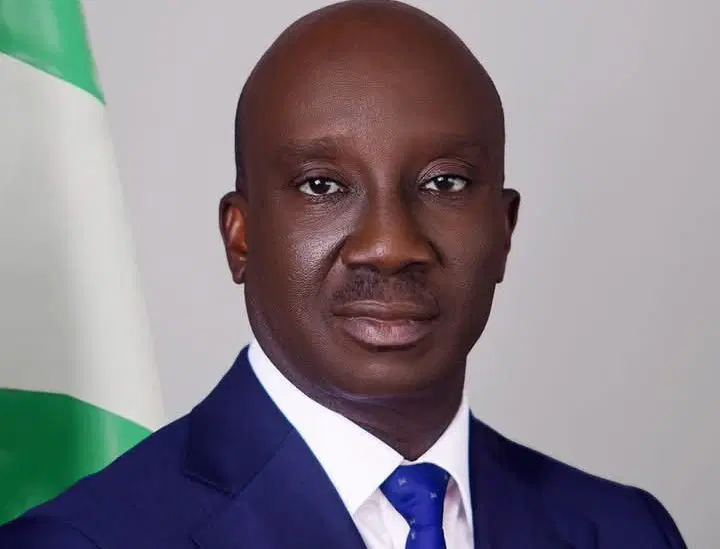
Some say Governor Monday Okpebholo is the reincarnation of late Ambrose Alli. Others see him in the class of late Gen. Samuel Ogbemudia in the old Bendel State. I have also heard people saying Governor Monday Okpebholo is in a class of his own because of the ongoing massive infrastructure development in the state.
As a matter of fact, both Alli and Ogbemudia’s developmental imprint remain visible decades after the state was split into Edo and Delta and after their demise.
Many of the roads, schools and public institutions established during that period still serve the people today, standing as reminders that visionary leadership can leave legacies that outlive administrations.
It is therefore not surprising that some residents have begun to draw parallels between that past and the current infrastructure drive being pursued by Governor Monday Okpebholo.
Since assuming office, Governor Okpebholo has placed considerable emphasis on infrastructure development, particularly road construction and rehabilitation. In roughly one year and three months in office, the administration has initiated about 28 road projects covering an estimated 255 kilometres across Edo State’s 18 local government areas.
These projects cut across the three senatorial districts, reflecting an effort to spread development evenly across the state. Among the most prominent are the flyover projects at Ramat Park and along Sapele Road near Adesuwa Junction in Benin City, both designed to ease traffic congestion and improve urban mobility.
Beyond the state capital, other strategic projects are underway. Rehabilitation works on failed portions of the Benin–Auchi Road is ongoing and that alone is addressing one of the state’s most important transport corridors.
Additional road construction and upgrade works are ongoing in communities such as Ogba-Evbuodia, Uholor, Irhue-Obagie and Amufi. Meanwhile, projects like the Upper Airport Road, Temboga Road, Uteh-Ekiuwa Road and Palace Road in Uteh are gradually improving connectivity in urban and peri-urban areas.
A particularly noteworthy feature of some of these projects is the integration of modern drainage systems designed to tackle persistent flooding. For years, communities such as Uteh have struggled with flood-related road damage, but recent drainage interventions have begun to address these longstanding problems.
Infrastructure development, however, is not limited to large road projects alone. The Okpebholo administration has also adopted a broader strategy aimed at strengthening road construction and maintenance at multiple levels.
At the heart of this approach is a three-pronged model that focuses on grassroots participation, rapid maintenance response and professional large-scale construction.
The first pillar of this strategy involves empowering local government councils to take greater responsibility for community and rural roads. Across Nigeria, many local roads fall within the jurisdiction of local authorities, yet they often remain neglected due to a lack of equipment and operational capacity.
To bridge this gap, the Edo State Government recently procured and distributed 54 pieces of heavy construction equipment to the 18 local government councils. The equipment — including graders, excavators and rollers — is intended to support road grading, rural access development, drainage rehabilitation and community-based infrastructure projects.
This decentralised approach represents a significant shift in infrastructure governance. By bringing road maintenance closer to the grassroots, local councils are better positioned to respond quickly to infrastructure needs within their communities.
Instead of waiting for state intervention, local authorities can now address deteriorating roads before they become major problems. For rural communities, this could translate into improved access to markets, schools and healthcare facilities.
The second pillar of the administration’s strategy lies in strengthening road maintenance through a Rapid Response mechanism within the Ministry of Works.
As part of early administrative reforms, the governor restored the Ministry of Works and enhanced its operational capacity. The ministry has since been equipped with both light and heavy-duty machinery to support routine maintenance and emergency repairs.
This initiative reflects a shift toward proactive infrastructure management. Rather than waiting until roads deteriorate completely before repairs are undertaken, the Rapid Response system allows maintenance teams to intervene quickly when potholes, erosion or drainage failures appear.
Early intervention is widely regarded as the most effective approach to road maintenance. Addressing defects at an early stage not only extends the lifespan of roads but also prevents minor issues from escalating into costly structural failures.
For road users, this means fewer disruptions, safer travel conditions and a more reliable transportation network.
The third pillar of the governor’s infrastructure strategy involves engaging reputable construction companies to execute large-scale and technically complex projects across the state.
Major road construction projects, including flyovers, bypasses and urban corridors, are being handled by established engineering firms with the technical expertise required for such tasks. The administration’s willingness to engage experienced contractors reflects an understanding that quality infrastructure depends heavily on professional execution.
The state government has also demonstrated a readiness to collaborate with the Federal Government in addressing certain federal roads within Edo State. Such cooperation ensures that critical transportation routes serving the state are not left unattended due to jurisdictional boundaries.
Complementing these efforts is a strong emphasis on oversight and accountability. Infrastructure projects often suffer when contractors operate without effective supervision. The Okpebholo administration has therefore prioritised regular project inspections and monitoring to ensure adherence to timelines and quality standards. Through close supervision, the government aims to ensure that public investments in road construction yield durable infrastructure capable of serving the state for decades.
Beyond transportation, the benefits of improved road infrastructure are far-reaching. Good roads facilitate the movement of agricultural produce from rural areas to urban markets, reduce travel time for commuters and support the expansion of businesses.
They also improve access to schools, hospitals and other essential services, thereby enhancing the overall quality of life for citizens.
Recognising the importance of sustaining this momentum, the administration allocated about N305 billion for road projects in the 2026 state budget. This substantial allocation signals a continued commitment to infrastructure development as a cornerstone of governance.
The governor’s efforts have not gone unnoticed. The Oba of Benin, Oba Ewuare II, recently acknowledged the administration’s developmental strides and encouraged the government to sustain its people-focused initiatives.
For many residents, however, the most convincing evidence lies not in official statements but in visible changes on the ground. Roads are opening up previously neglected communities, drainage projects are reducing flooding and infrastructure investments are gradually restoring public confidence.
A popular Bini proverb says that when a man pounding yam sees his strength appreciated, he is encouraged to give even more. The message from many parts of Edo State appears to reflect this sentiment: recognition should inspire greater effort.
Yet the task ahead remains substantial. Infrastructure transformation is rarely achieved overnight, and the real test of any development agenda lies in consistency.
For now, Governor Okpebholo has set a direction built on construction, maintenance and grassroots participation. The ultimate measure of success will lie in the durability of the roads, the connectivity of communities and the lasting improvement in the daily lives of Edo residents.
In the final analysis, infrastructure policies are judged not by their design but by their results. If the momentum is maintained, the current wave of development may well echo the enduring legacy of purposeful leadership once associated with late Ambrose Alli and late Samuel Ogbemudia.
Leave a Reply